It doesn’t ask for your attention
It doesn’t ask for your attention.
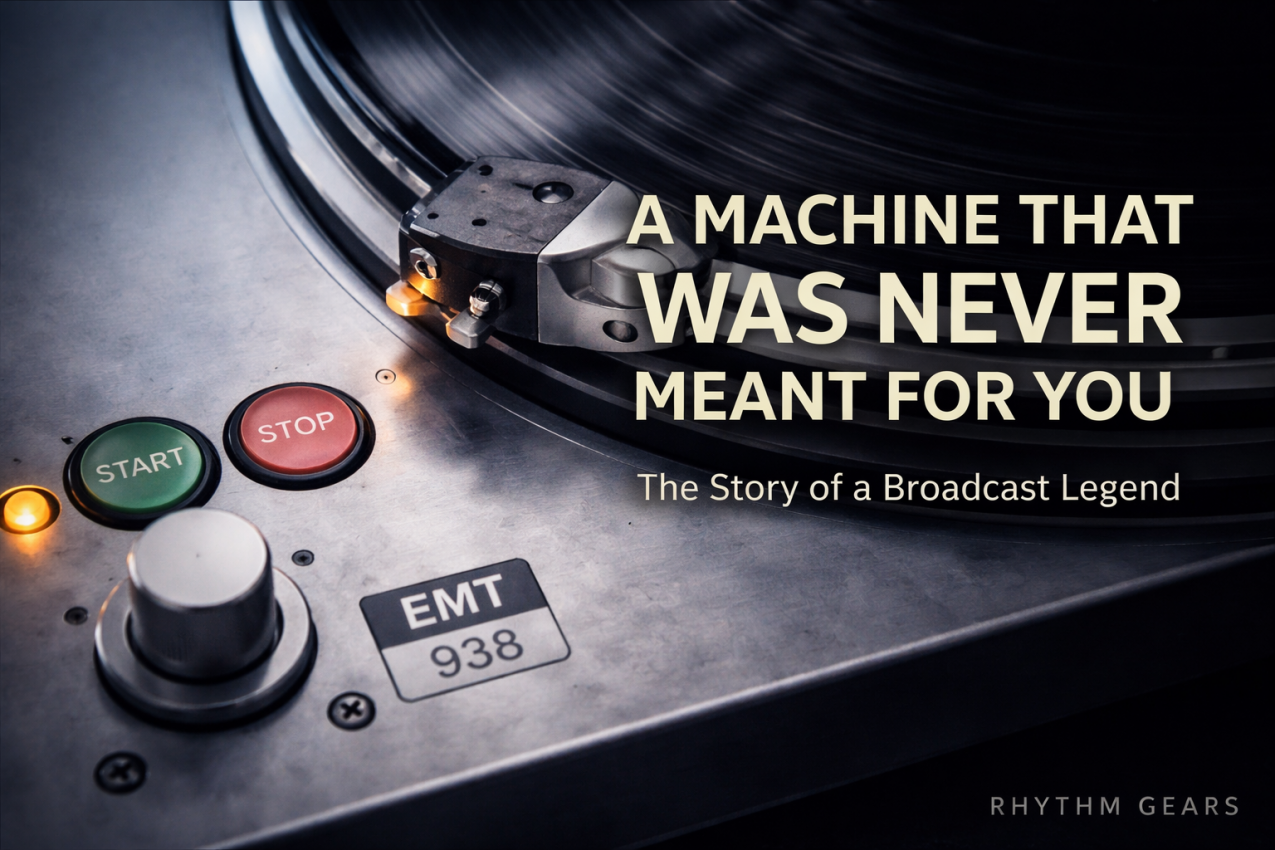
It assumes you already understand what it is. There’s a certain kind of silence that lives around machines like this—not the absence of sound, but the absence of distraction. The EMT 938 belongs to that silence. It comes from a time when music did not float freely in the air, waiting to be tapped, skipped, or reshuffled. It had weight. It had edges. And it required someone—somewhere—to take responsibility for it. This is not where music begins.
This is where it is handled.
A room you were never in
Before streaming platforms learned your habits, there were rooms where music was decided. Not discovered. Not recommended. Decided. Picture it. A narrow broadcast studio. The air is still, carrying the faint warmth of equipment that has been running for hours. A voice fades out—measured, deliberate. No urgency. No chaos. Just timing. A hand reaches forward, places a record on the platter, aligns it without hesitation. There is no spectacle here. The EMT 938 does not react. It responds. Immediately. Precisely. Without interpretation. In that moment, the machine is not playing music.
It is delivering it to the world.
When music required a person
There was a time when listening wasn’t passive. Music didn’t follow you. You followed it. You waited for it. You tuned into it. And somewhere, out of sight, someone else made sure it arrived exactly when it should. Machines like the EMT 938 were not accessories to that process—they were its backbone. There were no second chances. No buffering. No replay button. No algorithm adjusting itself to your mood. Just a chain of trust: from operator to machine, from machine to listener. And the machine never broke that trust.
The design of certainty
At first glance, it doesn’t try to impress you. No polished curves. No exaggerated finishes. No attempt to look “luxurious.” The EMT 938 feels almost indifferent to aesthetics—as if beauty was never part of the conversation. But spend time with it, and something shifts. The layout begins to make sense. The controls feel intentional. Every element exists for a reason, and nothing exists without one. It doesn’t guide you—it expects you to know. Buttons don’t invite. They confirm.
The tonearm doesn’t float. It positions. This is design not for admiration, but for execution. And in that honesty, it becomes something else entirely.
Not built for homes
The truth is simple: this machine was never meant for you. It wasn’t designed for living rooms or late-night personal listening sessions. It wasn’t built to sit beside a couch or to be admired between conversations. The EMT 938 belonged to institutions—radio stations, broadcast centers, places where music carried responsibility. It existed in environments where mistakes were not aesthetic—they were audible. And so, it was built differently. Not softer. Not friendlier.
Just more certain.
What changed wasn’t the machine
Today, music behaves differently. It bends. It adapts. It follows you from room to room, from mood to mood, from moment to moment. It asks nothing from you. Not patience. Not attention. Not even intention. And somewhere along the way, the distance between you and music disappeared. The EMT 938 reminds you of that distance—not as nostalgia, but as contrast. Standing in front of it feels unfamiliar, not because it is old, but because it is uncompromising. It does not adjust itself for convenience. It does not simplify its presence. It remains exactly what it was built to be. And in doing so, it quietly exposes how much everything else has changed.
A different way of listening
This is not about better or worse. It’s about a different relationship. A time when music was not endless, but arranged.
Not consumed, but placed.
Not owned, but experienced through a system larger than yourself. Machines like the EMT 938 were part of that system. They didn’t create emotion. They ensured its delivery. Cleanly. Reliably. Without interference. And maybe that’s what feels so distant now. Not the sound.
But the structure around it.
It doesn’t belong to nostalgia
It’s easy to look at something like this and feel a sense of longing—to imagine a slower, more “authentic” time. But the EMT 938 resists that kind of romanticism. It isn’t sentimental. It doesn’t carry memory in the way we do. It carries function. Repetition. Discipline. Years of doing the same thing, the right way, without deviation. What we feel when we see it is not nostalgia.
It’s recognition. Recognition of a world where music required effort—
and machines were built to match that effort.
A machine that remains unchanged
The EMT 938 has not evolved. It hasn’t adapted itself to modern habits or softened its edges for contemporary expectations. It stands exactly where it always did—firm, precise, and quietly distant. And maybe that’s why it feels so powerful today. Because in a world that constantly changes to suit us,
this is something that refuses to.
The distance remains
It doesn’t try to welcome you.
It doesn’t try to explain itself. It simply exists—as it always has. A machine from a time when music was not just played—
it was placed. And maybe that is why it still feels out of reach. Not because it belongs to the past,
but because it belongs to a way of listening
that we no longer practice.
1. What is the EMT 938?
The EMT 938 is a professional broadcast turntable designed for radio stations and studio environments, built for precision, reliability, and continuous use rather than casual listening.
2. Why was the EMT 938 not meant for home use?
It was engineered for controlled broadcast settings where timing and accuracy were critical. Its design prioritizes function over comfort, making it less suited for typical home listening experiences.
3. What makes broadcast turntables like the EMT 938 different from regular turntables?
Broadcast turntables focus on instant start, durability, and operational precision, whereas consumer turntables are designed more for convenience, aesthetics, and personal enjoyment.
4. Is the EMT 938 still relevant today?
Yes, but in a different way. Today it is valued by collectors, audiophiles, and enthusiasts who appreciate its engineering and the culture it represents rather than its original broadcast role.
5. Does the EMT 938 offer better sound quality than modern turntables?
Not necessarily “better” in a universal sense. Its strength lies in stability and accuracy, while modern turntables may offer more flexibility and user-friendly features.
6. Why do vintage broadcast machines feel more “serious”?
Because they were built for responsibility, not leisure. Every element was designed to perform under pressure, which gives them a more disciplined and purposeful character.
7. Who used machines like the EMT 938?
Radio operators, sound engineers, and broadcasting professionals used these machines to manage and deliver music to large audiences.
8. Can you still use the EMT 938 at home today?
Yes, but it requires understanding and proper setup. It’s less about convenience and more about experiencing a different way of interacting with music.
9. Why is the EMT 938 considered iconic?
It represents a time when music distribution was controlled, intentional, and human-driven—making it a symbol of a very different listening culture.
10. What does the EMT 938 represent beyond being a turntable?
It represents discipline, precision, and a period when music required effort, structure, and responsibility rather than instant access.

 September 7th, 2026
 September 1st, 2026
 August 18th, 2026
 July 19th, 2026