
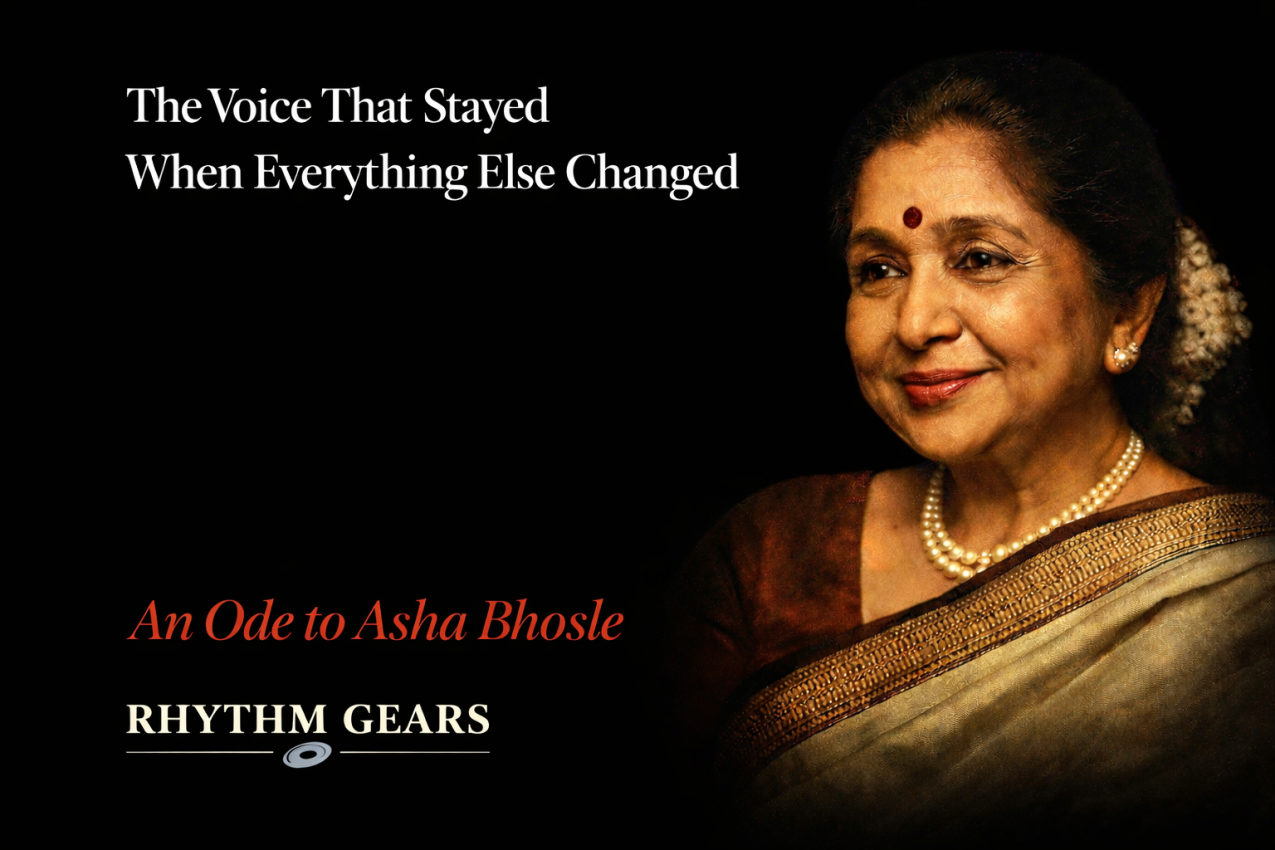
The Voice That Stayed When Everything Else Changed — An Ode to Asha Bhosle
There are some lives that can be measured in years.
And then there are lives like Asha Bhosle ’s—measured in moments they gave to others. Born on 8 September 1933, in Sangli, Maharashtra, Asha didn’t step into music as a choice—it was survival, inheritance, and destiny all at once. Her first recorded song, “Saawan Aaya” from the Marathi film Majha Bal (1943), wasn’t the beginning of fame—it was the beginning of a journey that would quietly reshape Indian music forever.
Why She Was Loved — Beyond Just Songs
People didn’t just love Asha Bhosle for her voice.
They loved her because she felt human. Where perfection often builds distance, Asha built connection. She could be playful in a cabaret, soulful in a ghazal, romantic, mischievous, vulnerable—all within the same breath. Her voice didn’t sit above the listener.
It sat beside them. That’s rare. That’s why it stayed.
The Songs That Became Memories
Some songs don’t belong to films anymore—they belong to people. And Asha Bhosle gave us many of those:
- “Piya Tu Ab To Aaja” (Caravan, 1971)
- “Dum Maro Dum” (Hare Rama Hare Krishna, 1971)
- “Chura Liya Hai Tumne” (Yaadon Ki Baaraat, 1973)
- “Aao Huzoor Tumko” (Kismat, 1968)
These weren’t just hits.
They became moods, identities, entire phases of life.
A Life That Touched Cinema Beyond Singing
While she ruled playback singing, Asha Bhosle also briefly appeared on screen.
She acted in films like Mai (2013), where her presence felt less like acting and more like a continuation of her artistic spirit. Because for her, expression was never limited to just one medium.
A Genre of Her Own
If you try to define Asha Bhosle by genre, you’ll fail. She sang cabaret, classical-based compositions, ghazals, pop, and folk-inspired melodies. But the truth is—her real genre was feeling. She didn’t stay in one space.
She expanded the space.
More Than a Career — A Presence
Decades passed. Technology changed.
Voices came and went. But Asha Bhosle didn’t fade into the past.
She became part of it. Part of old homes, late-night drives, radio memories, and vinyl collections. She became something you don’t just hear—
you return to.
Closing Tribute
Asha Bhosle’s legacy is not just in the number of songs she sang.
It is in the number of lives she quietly touched. In the feelings she gave words to.
In the silences she filled. And in the strange, beautiful way her voice still finds us—
exactly when we need it.
End Line
Some artists are remembered.
Some are replayed. And then there are voices like hers—
that never really leave.
-
 September 7th, 2026
 -
 September 1st, 2026
 -
 August 18th, 2026
 -
 July 19th, 2026