
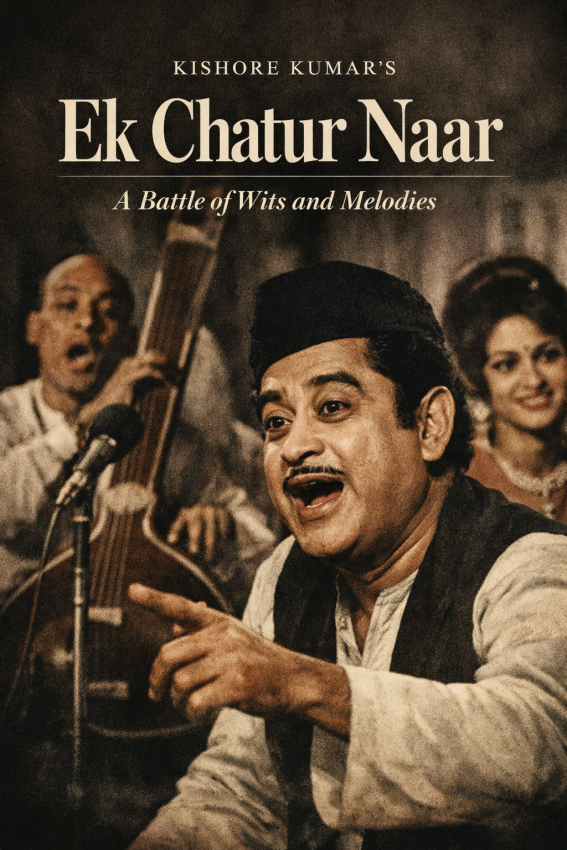
Ek Chatur Naar: A Song That Laughs at Perfection...
? A Room Full of Watching Faces
Before the first note is sung, the room is already divided. On one side, there is discipline—posture, training, the quiet confidence of someone who knows the rules.
On the other, there is something looser. Less certain, perhaps. But alive. The scene from Padosan doesn’t begin like a song. It begins like a situation waiting to turn into one. People are watching. Not just with interest—but with expectation.
Something is about to be proven.
The Idea of “Correct” Music
In the India of that time, classical music carried weight. It was not just a style—it was authority. Years of training, rigid structures, a kind of seriousness that demanded respect. To sing classically was to stand on tradition. And then, into this space, enters a different kind of voice. Not careless—but unconcerned with proving anything.
A Voice That Refuses to Behave
When Kishore Kumar begins, it doesn’t feel like an answer. It feels like a disruption. There’s something playful in the way he approaches the line—as if he’s aware of the rules, but chooses not to follow them too closely. Notes bend. Words stretch. The rhythm loosens, then tightens again. And slowly, something shifts. The performance stops being about who sings better. It becomes about who understands the moment more.
The Performance Inside the Voice
He shifts—sometimes within a single line. A phrase begins lightly, almost teasing…
and then suddenly carries intent. At moments, he seems to mimic the very structure he’s playing against—only to twist it, gently, into something else. It’s not imitation. It’s commentary.
Between Skill and Spirit
Across from him, Mehmood ’s character holds onto precision. Every note is placed carefully. Every movement carries discipline. There is no room for accident. And yet, as the exchange continues, something becomes clear. Skill is present on both sides. But only one of them is willing to let go of it.
The Moment the Song Changes
There comes a point—quiet, almost unnoticeable—when the song stops being a contest. The audience inside the scene reacts first. Their attention shifts. Their expectations loosen. The structure remains, but the meaning changes. What began as a demonstration of control becomes something more unpredictable.
Something closer to play. And in that shift, the song finds its identity.
What the Song Leaves Behind
Long after the scene ends, what remains is not just the melody. It is the feeling of having witnessed something slightly out of place—
a moment where seriousness was met not with resistance, but with lightness. Not mocked. Not dismissed. Just… reinterpreted.
A Song That Doesn’t Choose Sides
It would be easy to say the song is about one style winning over another. But it doesn’t feel that simple. Ek Chatur Naar doesn’t reject classical music.
It doesn’t celebrate chaos blindly. Instead, it sits somewhere in between. Acknowledging structure
while quietly reminding us that music, at its core, is not just about getting it right. It’s about making it feel alive.
-
 September 7th, 2026
 -
 September 1st, 2026
 -
 August 18th, 2026
 -
 July 19th, 2026