
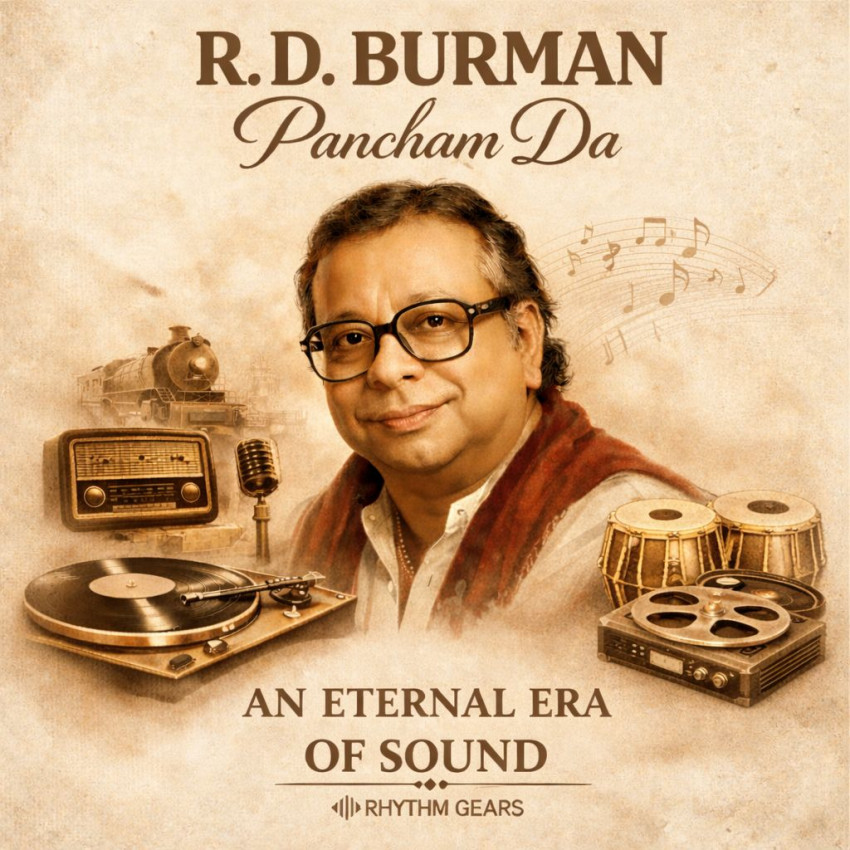
An eternal era of sound — celebrating Pancham Da’s finest moments and the everlasting legacy.
An Eternal Era of Sound — Pancham Da and the Feeling of a Time That Refuses to Fade
There are composers whose work belongs to a decade, and then there are composers whose work belongs to memory itself. Pancham Da — the restless, curious, endlessly playful force we know as R. D. Burman — exists in that rare space where music stops being tied to time. Ask anyone who grew up in India — whether their childhood unfolded in the crackle of radio, the whirr of cassette decks, or the soft glow of vinyl spinning on a Sunday morning — and somewhere in their story, Pancham Da is playing quietly in the background. Not as nostalgia. As presence.
The Sound of a Curious Mind
It’s tempting to talk about Pancham Da in terms of “hits”, but that would miss the point entirely. What defined him was curiosity — the kind that makes a musician treat the studio not as a workplace but as a laboratory. There are stories of him experimenting with the sound of breath blown across bottles, tapping rhythms on everyday objects, layering textures simply because he wanted to hear what would happen. He wasn’t chasing novelty; he was chasing possibility. In many ways, Pancham Da sounded like someone who was always listening — not just to music, but to the world.
When Bombay Found a New Pulse
By the early 1970s, Hindi film music was already rich with tradition, but Pancham Da brought something different: motion. Listen to the opening bars of his compositions from that era and you hear a city waking up — taxis, conversations, late nights, restless energy. His arrangements carried a sense of movement that felt modern without abandoning emotional depth. Films like Hare Rama Hare Krishna, Amar Prem, Yaadon Ki Baaraat, and Sholay didn’t just feature songs; they carried atmospheres. Each soundtrack felt like a world you could step into. That was his gift — making sound feel spatial, almost cinematic.
Emotion Without Performance
What made Pancham Da extraordinary wasn’t just innovation. It was sincerity. There’s a certain honesty in his melodies — a feeling that the music isn’t trying to impress you, only to reach you. Whether it’s a song of longing or quiet joy, the emotion feels unforced, as if it simply exists. This is why listeners who never lived through his era still feel close to his music. Because emotional truth doesn’t age.
The First Step — A Beginning That Hinted at Everything
His journey as an independent composer began with Chhote Nawab in 1961, and the song “Ghar Aaja Ghir Aaye” carried the unmistakable sign of a new voice — melodic, sensitive, yet subtly adventurous. It didn’t announce a revolution. It whispered one.
Nights in the Studio
Musicians who worked with Pancham Da often recall sessions that stretched long into the night — not out of pressure, but out of excitement. Ideas would emerge in conversation, arrangements would evolve organically, and laughter was as common as rehearsals. He had a way of making the studio feel like a shared space of discovery rather than hierarchy. Perhaps that’s why his recordings feel alive — they carry the energy of collaboration.
The Final Chapter — A Quiet Masterpiece
Years later, when 1942: A Love Story released, listeners heard something remarkable: music that felt both mature and deeply tender. Songs like “Kuch Na Kaho” sounded almost reflective — as if Pancham Da was looking back gently at a lifetime of sound. It became, in many ways, a farewell that felt less like an ending and more like a lingering note.
Listening Today — Why the Music Still Breathes
Play Pancham Da on a revealing system — a turntable, a pair of speakers that know how to disappear into the room — and something interesting happens. Details emerge: the soft decay of a note, the placement of percussion, the warmth of analog recording. His music rewards patience. It invites listening rather than demanding attention. And perhaps that is why it continues to endure — because it offers something deeper than entertainment. It offers experience.
A Composer Who Refused Boundaries
Pancham Da moved effortlessly between styles — classical influences, jazz phrasing, rock rhythms, folk sensibilities — never treating genres as walls. Instead, he treated them as colours. This openness gave his music a sense of freedom that still feels refreshing today.
Why His Era Never Ends
To say Pancham Da belongs to the past is to misunderstand what he created. His music isn’t locked in time; it resurfaces whenever someone presses play and listens closely. An era doesn’t end when calendars move forward. It ends when people stop feeling it. And Pancham Da continues to be felt — in quiet evenings, in shared memories, in the simple act of listening.
Listening Suggestions
- Pancham Da vinyl records — for experiencing the warmth and depth of original recordings (https://www.rhythmgears.com/categories/vinyle-records)
- CD editions — for clarity and archival listening (https://www.rhythmgears.com/categories/audio-cds)
- Warm, expressive speakers — systems that reveal vocal texture and orchestral detail(https://www.rhythmgears.com/categories/speakers)
FAQ — Pancham Da in Perspective
Why is Pancham Da considered timeless?
Because his music balances innovation with emotional sincerity, making it relatable across generations.
What defines his golden era?
The 1970s and early 1980s, when his creativity reshaped film music.
What was his first song?
“Ghar Aaja Ghir Aaye” from Chhote Nawab.
What is often seen as his final masterpiece?
The soundtrack of 1942: A Love Story.
Closing Thought
Some music belongs to playlists. Some belongs to history. And some — like Pancham Da’s — belongs to the quiet space between memory and feeling. An eternal era of sound isn’t a metaphor in his case. It’s simply the truth.WE WILL MISS YOU SIR
-
 September 7th, 2026
 -
 September 1st, 2026
 -
 August 18th, 2026
 -
 July 19th, 2026