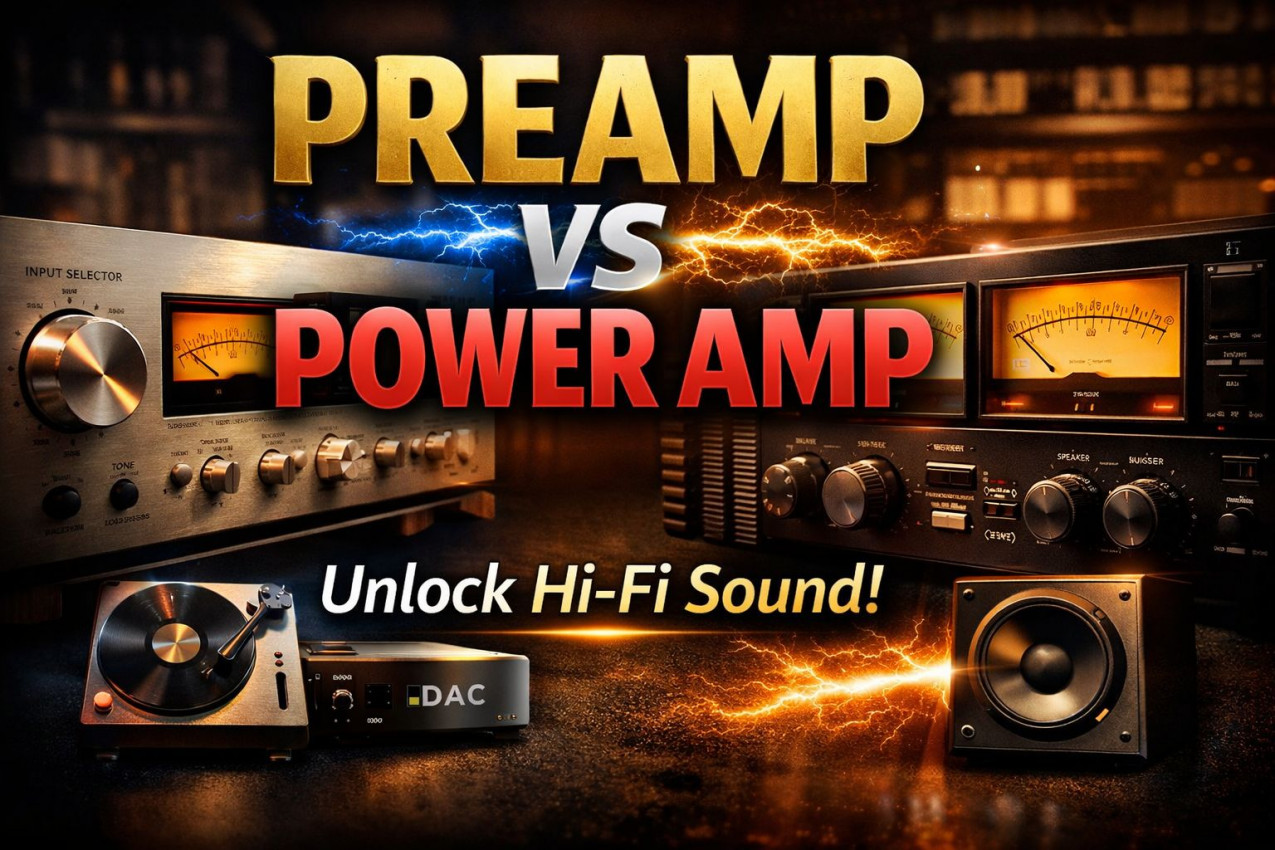
What Do Pre Amplifiers and Power Amplifiers Actually Do? A Complete Audiophile Guide?
When building a serious hi-fi or audiophile music system, one of the most important — yet often misunderstood — concepts is the difference between a pre amplifier and a power amplifier. Many music lovers struggle with questions like: Why does my system lack clarity? Why does the sound feel weak at higher volumes? Do I really need separate components? Understanding how these two pieces of equipment work together can instantly transform your listening experience and help you make smarter upgrade decisions. At its core, the audio chain is simple: a source (like a turntable, DAC, or streamer) produces a delicate signal that needs careful handling before it can drive speakers. The pre amplifier acts as the control center, managing sources, adjusting volume, and ensuring the signal remains clean and detailed. The power amplifier acts as the muscle, taking that refined signal and delivering the energy needed to move speaker drivers with authority and precision. When these roles are performed correctly, music sounds more open, dynamic, and emotionally engaging. This guide is designed to solve real problems faced by beginners and seasoned audiophiles alike — from eliminating noise and distortion to achieving better soundstage and control — while helping you understand why separates are often preferred in high-end audio.
Why Understanding Preamps and Power Amps Is Crucial
- Avoid weak or lifeless sound caused by improper amplification
- Ensure your speakers receive clean and sufficient power
- Improve detail retrieval, imaging, and musical realism
- Make confident buying decisions without confusion
- Build a scalable system that can grow over time
- Essential knowledge for vinyl lovers and digital listeners alike
What Is a Pre Amplifier? — The Brain of Your System
A pre amplifier (often called a preamp) prepares the audio signal before it reaches the power stage. Because signals coming from sources — especially turntables — are extremely low in voltage, they need proper conditioning to preserve detail and reduce noise.
Key Functions of a Preamp:
- Selects between multiple audio sources (phono, CD, DAC, streamer, tape)
- Controls volume with precision and channel balance
- Amplifies low-level signals to line level
- Maintains signal integrity with minimal coloration
- Provides tone shaping or bypass options (depending on design)
- Sends a clean, stable signal to the power amplifier
A high-quality preamp can dramatically improve transparency, making vocals clearer, instruments more separated, and the soundstage wider. .
What Is a Power Amplifier? — The Muscle Behind the Music
While the preamp refines the signal, the power amplifier’s job is to deliver the current and voltage necessary to drive speakers. Without sufficient power, even the best speakers will sound compressed and lack impact.
Key Functions of a Power Amplifier:
- Boosts signal strength to speaker-driving levels
- Provides headroom for dynamic peaks in music
- Controls speaker drivers for tight bass and accuracy
- Maintains low distortion even at higher volumes
- Handles complex speaker loads effortlessly
A powerful, well-designed amplifier ensures music feels alive — with punch, scale, and realism.
Explore our website to select the right power amplifier: https://www.rhythmgears.com/categories/pre-amps-and-power-amps
Common Problems This Guide Helps Solve
- System sounds thin or lacks depth
- Volume needs to be turned up too high to feel engaging
- Distortion at louder levels
- Confusion between integrated amps and separates
- Noise or hum in vinyl setups
- Difficulty matching components
By understanding the role of each component, you can troubleshoot these issues and optimize your system for the best performance.
Why Audiophiles Prefer Separate Preamps and Power Amps
Separating these functions allows each unit to specialize. The preamp focuses on signal purity, while the power amp focuses on current delivery. This separation reduces interference, improves clarity, and offers upgrade flexibility.
Benefits of Separates:
- Greater sonic refinement and transparency
- Better channel separation and imaging
- More upgrade paths over time
- Improved power handling for demanding speakers
- Reduced electrical noise
For high-end systems, this approach often results in a more immersive and realistic listening experience.
Practical Use Cases
- Vinyl setups needing phono amplification
- High-resolution digital systems seeking clarity
- Large speakers requiring strong power delivery
- Home listening rooms aiming for premium sound
- Audiophile upgrades from integrated amplifiers
Conclusion — Unlocking True High-Fidelity Sound
Understanding what pre amplifiers and power amplifiers actually do is the foundation of building a system that reproduces music with accuracy and emotion. When the signal is carefully managed and properly amplified, every nuance — from subtle textures to explosive dynamics — becomes more apparent. Whether you’re rediscovering classic vinyl records or streaming high-resolution tracks, the synergy between these components ensures a listening experience that feels natural, powerful, and deeply satisfying. If you’re aiming to elevate your system, mastering this knowledge will help you avoid costly mistakes and bring you closer to true hi-fi performance.
FAQ — What Do Pre Amplifiers and Power Amplifiers Actually Do?
What is the difference between a pre amplifier and a power amplifier?
A pre amplifier manages the audio signal — selecting sources, controlling volume, and preparing a clean signal — while a power amplifier boosts that signal to a level strong enough to drive speakers. Think of the preamp as the control center and the power amp as the engine.
Can a preamp change the sound signature?
If your system sounds strained, lacks dynamics, or distorts at higher volumes — especially with large or inefficient speakers — you may benefit from a more powerful amplifier.
How do I know if I need more amplifier power?
Separate amplifiers often provide higher performance and upgrade flexibility, while integrated amplifiers are simpler and more space-efficient. The choice depends on system goals and budget.
Are separate amplifiers better than integrated amplifiers?
Yes. A phono preamp specifically boosts and equalizes the signal from a turntable cartridge to line level, while a regular preamp handles source switching and volume control.
Is a phono preamp different from a regular preamp?
Insufficient power can cause weak bass, compressed dynamics, distortion at higher volumes, and poor control over speakers. A properly matched power amplifier ensures full performance.
What happens if my amplifier doesn’t have enough power?
Yes. A high-quality preamp can lower noise, improve detail retrieval, and maintain signal integrity, leading to clearer vocals, better imaging, and a more natural presentation.
Does a preamp improve sound quality?
Separates reduce electrical interference and allow each component to specialize in its function. This often results in cleaner sound, better dynamics, improved soundstage, and easier system upgrades.
Why do audiophiles prefer separate preamps and power amps?
Generally, no. A power amplifier needs a variable signal with volume control, which is typically provided by a preamp or a source with preamp functionality (like some DACs with volume control).
Can I use a power amplifier without a preamp?
You need a preamp if you’re using separate power amplification or sources like turntables that output low-level signals. Many integrated amplifiers already include a built-in preamp, but dedicated units often offer better sound quality and flexibility.
Do I need a pre amplifier for my audio system?
A pre amplifier manages the audio signal — selecting sources, controlling volume, and preparing a clean signal — while a power amplifier boosts that signal to a level strong enough to drive speakers. Think of the preamp as the control center and the power amp as the engine.
-
 September 7th, 2026
 -
 September 1st, 2026
 -
 August 18th, 2026
 -
 July 19th, 2026