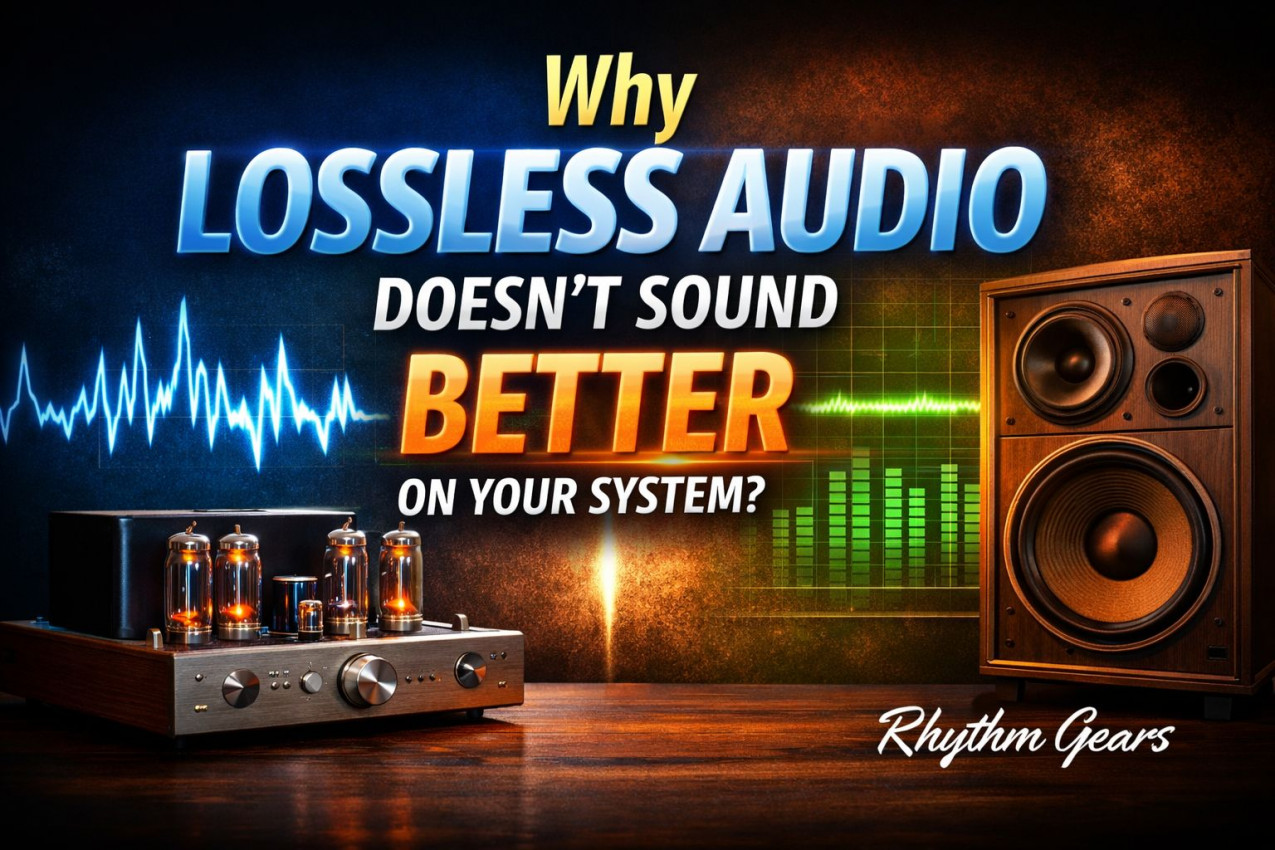
Why Does Lossless Audio Not Sound Better on My System???
Introduction: Why Lossless Audio Matters to Audiophiles
In a world dominated by streaming and compressed music, true audiophiles know one thing—music deserves to be heard as it was recorded. Lossless audio formats preserve every detail, every breath, every instrument’s natural decay. At Rhythm Gears, where vintage and high-end audio systems are celebrated, understanding lossless audio formats like FLAC, WAV, and DSD is essential to unlocking your system’s true potential.
What Is Lossless Audio?
Lossless audio formats store music without removing any data from the original recording.
Lossless ≠ High Volume
Lossless =
✔ Better dynamics
✔ Wider soundstage
✔ Natural instrument separation
✔ Analog-like warmth (on the right system)
Important: Lossless audio only shines when paired with a capable amplifier, DAC, and speakers.
FLAC – The Audiophile’s Practical Choice
What is FLAC?
FLAC (Free Lossless Audio Codec) compresses audio without losing quality, making it storage-friendly and widely supported.
Why Audiophiles Love FLAC
- Smaller file size than WAV
- Bit-perfect playback
- Supported by most DACs, streamers & media players
- Ideal for digital libraries
Best Paired With:
- Solid-state or tube amplifiers
- Vintage DACs with modern streaming
- High-resolution speakers
Link FLAC sections to:
- Vintage Integrated Amplifiers Collection (https://www.rhythmgears.com/categories/amplifiers)
- High Efficiency Speakers for Digital Audio (https://www.rhythmgears.com/categories/speakers)
WAV – Studio-Grade, Uncompressed Sound
What is WAV?
WAV files store audio exactly as recorded—no compression, no processing.
Sound Characteristics
- Extremely clean
- Highly detailed
- Neutral and transparent
Limitations
- Very large file sizes
- Poor metadata support
- Less practical for libraries
Best Use Case
- Studio monitoring
- Critical listening sessions
- Testing amplifiers and speakers
DSD – The Closest Digital Gets to Analog
What is DSD?
DSD (Direct Stream Digital) uses a completely different encoding method compared to FLAC and WAV. Originally developed for SACD, DSD is revered for its analog-like presentation.
Why Purists Prefer DSD
- Smooth highs
- Natural decay
- Emotional midrange
- Tube-friendly sound signature
Important Requirement
You need:
- A DSD-capable DAC
- High-quality amplifier
- Revealing speakers
Link DSD section to:
- https://www.rhythmgears.com/categories/tube-amplifiersTube Amplifiers Collection
- FLAC vs WAV vs DSD – Quick Comparison
| Format | Sound Quality | File Size | Best For |
|---|---|---|---|
| FLAC | Excellent | Medium | Everyday audiophile listening |
| WAV | Excellent | Very Large | Studio & testing |
| DSD | Exceptional | Very Large | Pure listening pleasure |
Why Lossless Audio Doesn’t Always Sound Better
Many listeners ask:
“Why doesn’t lossless audio sound better on my system?”
Common Reasons:
- Entry-level speakers
- Weak amplifier section
- Poor DAC quality
- Incorrect speaker matching
Lossless audio reveals flaws, not hides them.
❓ FAQs
Q1. Is FLAC better than MP3?
Yes. FLAC retains full audio data, while MP3 permanently removes details.
Q2. Can I hear a difference between WAV and FLAC?
On high-end systems, differences are minimal. FLAC is usually more practical.
Q3. Is DSD worth it?
Absolutely—if your DAC and amplifier support it properly.
Q4. Do vintage amplifiers support lossless audio?
Yes. With a good DAC, vintage amplifiers excel at lossless playback.
-
 September 7th, 2026
 -
 September 1st, 2026
 -
 August 18th, 2026
 -
 July 19th, 2026